

About Us
The Japanese Association of Prosthetists and Orthotists (JAPO) is Japan's only professional association representing nationally licensed prosthetists and orthotists.Founded in 1993, JAPO was incorporated as a legal entity in 2012 and authorized by the Cabinet Office as a Public Interest Incorporated Association in 2017.
JAPO works to enhance the competence, knowledge, and technical skills of prosthetists and orthotists, while promoting the development and dissemination of prostheses, orthoses, and other assistive devices. Its activities include scientific meetings, training seminars, continuing professional education, publication of academic journals and white papers, research and public information activities, and international cooperation.
Through these activities, JAPO contributes to public health, medical care, and social welfare in Japan and supports the improvement of quality of life for people who use prostheses, orthoses, and related assistive devices.
Background
The development of prosthetic and orthotics in Japan has been closely linked to the advancement of rehabilitation medicine, orthopaedics, and social welfare systems. The following timeline summarizes key milestones in the establishment of prosthetics and orthotics education, national licensure, and JAPO.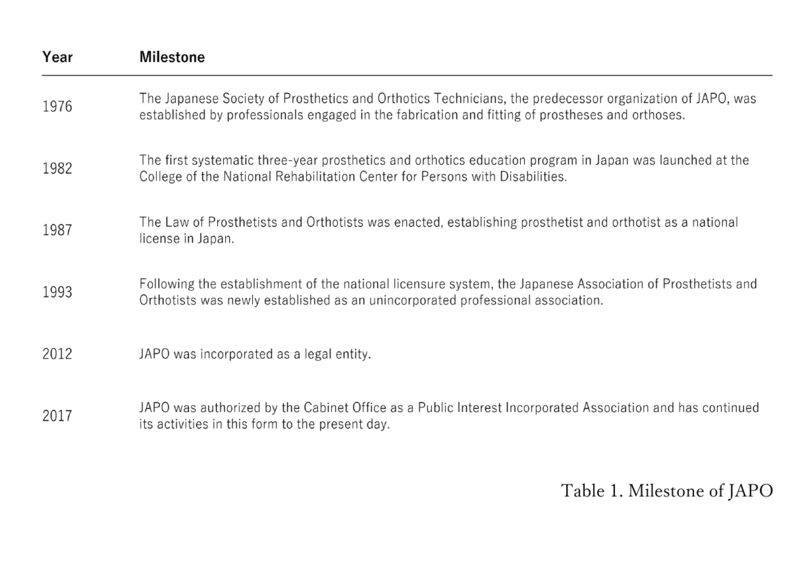 Under Japanese law, prosthetists and orthotists are professionals who, under the direction of a physician, take casts and measurements, fabricate prostheses and orthoses, and fit them to users. In Japan, prosthetics and orthotics are integrated into a single national qualification.
Today, JAPO supports the advancement of prosthetics and orthotics through professional education, academic and technical activities, research, publications, and international cooperation.
About the Law of Prosthetists and Orthotists
Under the Law of Prosthetists and Orthotists, the national license is given once a year to the candidates who passed the examination and gaduated from fully accredited colleges. Table 2 shows the number of approved facilities in Japan.
| Name | Capacity | Program |
|
The college of National Rehabilitation Center for Persons with Disabilities
Course of Prosthetics and Orthotics
|
10 | 3 years diploma |
|
Chubu Rehabilitation College
Department of Prosthetics and Orthotics
|
30 | 3 years diploma |
|
Kumamoto College of Medical Care Rehabilitation
Department of Prosthetics and Orthotics
|
25 | 3 years diploma |
|
Kobe College of Medical Welfare
Course of Prosthetics and Orthotics
|
30 | 4 years advanced diploma |
|
Seibu Gakuen Bunri's College of Medical Technology
Department of Prothetics and Orthotics
|
28 | 3 years diploma |
|
University of Human Arts and Sciences
Department of Rehabilitation Major of Prosthetics and Orthotics
|
30 | 4 years bachelor |
|
NIigata University of Health and Welfare
Department of Prosthetics & Orhtotics and Assistive Technology
|
40 | 4 years bachelor |
|
Hiroshima International University
Department of Comprehensive Rehabilitation
Major of Prosthetic and Orthotics
|
40 | 4 years bachelor |
|
Hokkaido University of Science
Faculty of Health Sciences
Department of Prosthetics and Orthotic
|
not accepting applications
(from 2024 entrance exam)
|
4 years bachelor |
Table 2.
Organizational Structure
JAPO is organized into six regional chapters and several committees, subcommittees, and working groups. The regional chapters support activities in each area of Japan,while the committees and working groups address specific professional, educational, academic, ethical, social, and international matters related to prosthetics and orthotics. This structure enables JAPO to coordinate its activities nationwide and to promote the development of the prosthetic and orthotic profession in Japan. Fig. 1 shows the organizational structure of JAPO.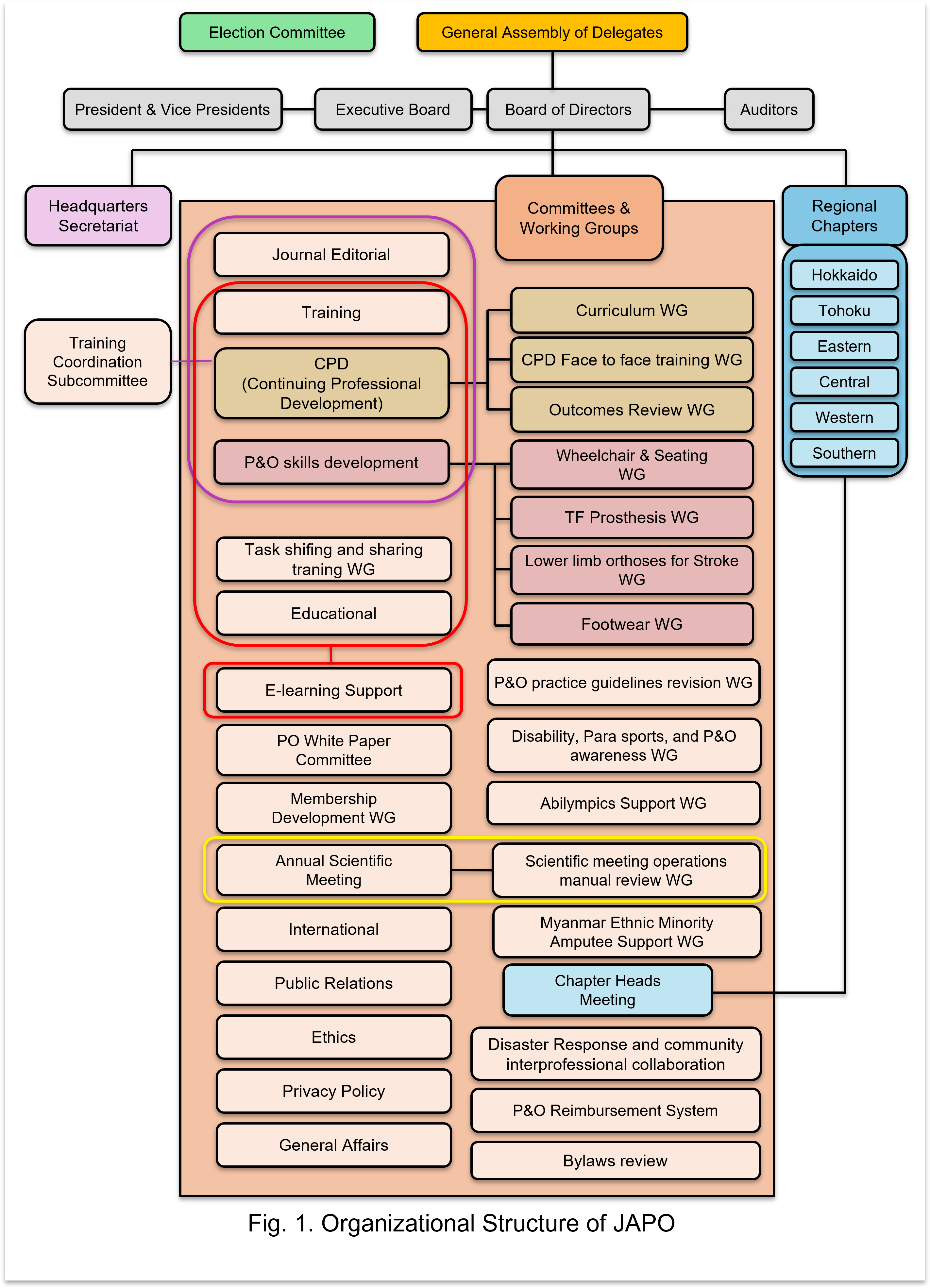
Activities
JAPO provides educational, academic, professional, and social activities for its members and for the development of prosthetic and orthotic services in Japan. These activities include scientific meetings, seminars, publications, continuing professional development, collaboration with related organizations, and international exchange.
■ Scientific and Educational Activities
JAPO organizes scientific meetings, seminars, and other educational programs to support the professional development of prosthetists and orthotists. These activities provide opportunities for members to update their knowledge, share clinical experience, and discuss current issues in prosthetics and orthotics.
■ Publications
JAPO publishes journals and other materials to share academic, clinical, technical, and professional information related to prosthetics and orthotics.
■ Social and Professional Activities
JAPO works with related organizations in health care, rehabilitation, education, and welfare to promote the appropriate provision and development of prosthetic and orthotic services.
■ International Activities
JAPO promotes international exchange and cooperation in the field of prosthetics and orthotics. These activities include supporting English sessions at the JAPO Annual Scientific Meeting, maintaining professional exchange with overseas organizations such as the Hong Kong Society of Certified Prosthetist-Orthotists, and contributing to international cooperation activities that utilize the expertise of prosthetists and orthotists.
Membership Statistics
Regular members are nationally licensed prosthetists and orthotists in Japan.Other categories include students, individuals and organizations that subscribe to JAPO publications, and those who support the objectives and activities of the Academy.Table 3 shows the number of JAPO members by membership type as of September 2025.
| Type of membership | Number |
| Regular | 2,219 |
| Subscribe | 56 |
| Supporting | 33 |
| Student | 624 |
| Honorary | 2 |
Table 3. Number of JAPO Membership by Membership Type.